The Applied Behavior Analysis (ABA) team discusses the power struggle between adults and children and strategies in assisting with preventing or de-escalating a power struggle situation/scenario.
The Power Struggle
We’ve all heard the phrase “choose your battles wisely”, and the power struggles with the people in our lives can easily apply. Let’s start with the Merriam-Webster (2024) definition, which is written simply as “a fight for control”. Many scenarios that we see in the clinical setting are surrounding a task that the individual does not want to do, which leads to the therapist being in a position to either be trapped in a power struggle or find an alternate way to get the individual to want to do the task. An example that can lead to a power struggle in other environments is when a child doesn’t want to eat the food that is on their plate, or a child not wanting to leave the playground when told it is time to go. Below we will be walking through some strategies that may assist in preventing or de-escalating a power struggle situation.
1. Set The Expectation.
Before arriving at a place/situation that may cause a power struggle, speak with the individual about what is expected of them throughout the situation. Sometimes understanding what is expected can prevent any misunderstandings that lead to a power struggle.
Example: Prior to going to the birthday party at the pool, a mom sat down with her child to explain that they can go swimming if they stay in the shallow end of the pool. She explains that since they cannot swim, it is not safe, and so if they do not follow this rule, they will have to stop swimming all together.
2. Have A Form Of Reinforcement Available.
Most of the time, you can simply ask the individual what they would like to have if they do what is asked of them. Some children may have a favorite toy that can be used to assist in these situations.
Example: Telling a child that they can have the iPad to play games if they sit quietly while grocery shopping. So, as long as they remain quiet, they have access to playing the game while grocery shopping is occurring.
3. Provide A Choice.
Choose options for the situation that would be deemed appropriate for the individual to choose. Whichever option they choose is what will be done. This helps them feel involved in the decision-making process and can assist in preventing a power struggle.
Example: A parent mentions to their child that they have errands to run, but they offer the child a choice of a place they would like to go to prevent the child getting frustrated going to all the non-preferred places. The parent could state, “We are almost done at the post office. You can choose where we go eat for lunch! Would you prefer Chick-Fil-A or Sonic?” They go to the place chosen by the child.
4. Use Visual Aids.
When using visual aids, we can select from a variety of them. Timers will be adequate in timely situations that involve leaving or transitioning to another activity at a specific time. Photos, schedules, or videos can be used to show what they need to do in the situation and help them understand more clearly the expectation.
Example: A parent plans to go to the park for 1 hour, but they know that leaving is difficult for their child. Having a timer that is set for one hour can help in setting the expectation when it is time to leave. When they first arrive, they set the timer and state “okay, we have one hour at the park and then we need to go get dinner”. At the end of the hour, the parent shows the child the beeping timer, and they pack up to go.
Example 2: A parent has a set of chores for their child, and they never get completed. A visual schedule of the chores can be created, and there is a higher likelihood that the expectation will be met. Bonus points if you design the chore chart to have elements the individual likes! (Maybe some superheroes or Disney characters.)

5. Premack Principle (First/Then).
The first/then method is used as a sort of compromise, and best works presented prior to the situation, but can be utilized to de-escalate as well. This typically requires something the child enjoys as a prize for doing the task required. This principle uses the same strategies as number 2 on our list. Many therapists use a visual to assist in implementing this principle. (See example image below.)
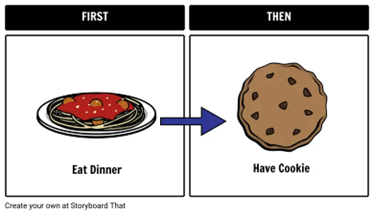
Example: You sit down for dinner and your teenager states, “I don’t want to eat my spaghetti. I just want a cookie.” In this scenario, you could state, “FIRST you need to eat your spaghetti and THEN we will eat a cookie.”
6. Mean What You Say.
Remember that if you do request a task be completed, that you follow through with any demand placed. This is what we call “instructional control”, and it helps reduce power struggles in the future when used consistently. Additionally, it shows the individual that if you do/do not do the task, there may be rewards/consequences.
Example: If someone tells a child that they can go outside, but only if they complete a specific task, the child should not be allowed to go outside unless that task is completed.
7. Break Down The Task/Situation.
People learn differently, and sometimes we don’t clearly understand the instructions all together. Try to breakdown the task into smaller parts, so that the individual only must focus on a small piece, rather than the whole picture.
Example: Someone is tasked to do the laundry but has never done it before. Someone else breaks it down into steps; throw dirty clothes in water – add soap – close door – set on wash cycle – press start. The individual can wash the clothes because they now know they smaller tasks involved.
8. Stop The Conversation.
Tell the individual that the conversation needs to pause, but it will continue later. This provides time for both parties to think about the situation.
Example: While at the park, a parent is speaking with their child about going to see a movie later that night. The child begins to get upset because it is not a movie they want to see. The parent can say, “Let’s talk about this later at home, and enjoy playing at the park for now.”
9. Provide Praise For Correct Actions.
When the individual is doing things correctly, even after doing something conflicting, provide verbal praise for the correct actions. By praising the correct actions, and not the incorrect actions, the individual learns that they are being reinforced for doing things correct. This will likely increase the correct actions occurring in the future.
Example: A child won’t sit down at the table to eat dinner, so the parent praises someone else who is sitting at the table correctly. The child then sits down, and the parent praises the child for sitting at the dinner table.
Conclusion
Every individual is different in how they learn and communicate their wants and needs. Sometimes, having a simple conversation with them can provide enough support to prevent a power struggle. In some cases, it can also be beneficial to use multiple strategies at once. None of these methods are guaranteed to work 100% of the time, but they can be beneficial to have if nothing else has been effective. We hope this information is beneficial in helping you navigate the power struggles in your life.
References
Biasbehavioral. (2020, January 22). Tips for avoiding or defusing a power struggle. BIAS. https://biasbehavioral.com/tips-for-avoiding-or-defusing-a-power-struggle/
Clever Prototypes, L. (n.d.). Free storyboard creator: Comic strip maker. Storyboard That. https://www.storyboardthat.com/storyboards/natashalupiani/first-then/copy
Merriam-Webster. (n.d.). Power struggle. In Merriam-Webster.com dictionary. Retrieved July 11, 2024, from https://www.merriam-webster.com/dictionary/power%20struggle
V., R. (2020, September 9). Free printable chore charts for kids!. Viva Veltoro. https://www.vivaveltoro.com/free-printable-chore-chart-kids/